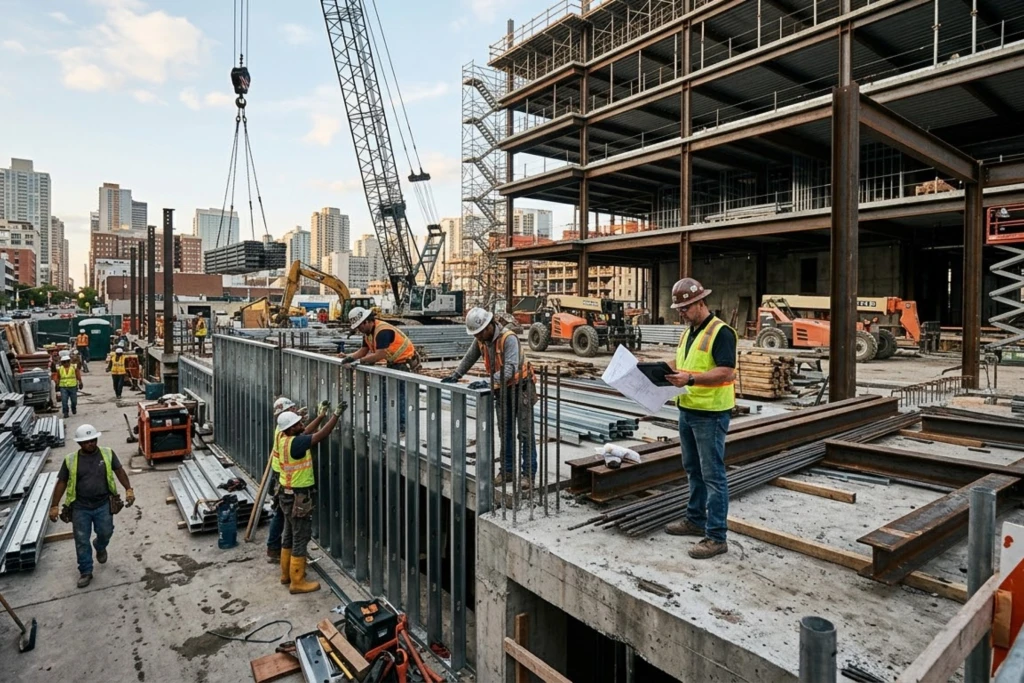
Construction Working Capital: Why Profitable Contractors Still Run Short on Cash
Construction cash flow is a timing problem, not a profitability one. Here's what every contractor should know about bridging the gap between job costs and draws.
Why Profitable Contractors Still Run Short on Cash
You can close a profitable month in construction and still not cover payroll. Labor, materials, subcontractors, and permits all leave your account before a single draw hits. Then you wait thirty, sixty, or ninety days for the money to come back.
Construction is one of the few industries where healthy margins don't guarantee healthy cash flow. That gap between money earned and money in the bank is where working capital earns its place.

The Sectors Behind Construction Cash Flow
The construction industry spans a wide range of specialties. Each one carries its own billing cycles, margin profiles, and capital needs.
- 1. Residential Construction: Single-family homes, multi-family housing, manufactured homes, renovations and remodeling.
- 2. Commercial Construction: Office buildings, retail spaces, restaurants, hotels, and medical facilities.
- 3. Institutional Construction: Schools, universities, government buildings, and research facilities.
- 4. Industrial Construction: Manufacturing plants, warehouses, refineries, and data centers.
- 5. Infrastructure and Heavy Civil: Highways, bridges, tunnels, airports, railroads, dams, water treatment plants, ports.
- 6. Environmental Construction: Remediation projects, brownfield redevelopment, land reclamation.
- 7. Specialty Trades:Electrical, HVAC, plumbing, masonry, concrete, roofing, flooring, painting, elevator work.
- 8. Agricultural and Rural Construction: Trades: Farm buildings, irrigation systems, greenhouses, utility work.
- 9. Power Generation Facilities:Solar farms, wind farms, hydroelectric plants, pipelines, transmission lines.
- 10. Prefabricated and Modular Construction: Pre-engineered metal buildings, portable structures.
- 11. Restoration and Renovation: Historic restoration, disaster recovery, energy-efficiency retrofits.
- 12. Real Estate Development:Land acquisition, zoning, infrastructure build-out, project financing.
- 13. Construction Management and Consulting: Project planning, contract administration, site supervision, quality control.
Every one of these sub-sectors has its own niche characteristics, but all of them depend on reliable access to working capital.

Bank Loans vs. Alternative Capital: What You Give Up Either Way
Traditional financing is often buried in bureaucracy — slow processes, rigid requirements, and paperwork that stalls projects for weeks. Every funding option carries a hidden cost, and the right choice depends on interest rates, your risk tolerance, and the specific circumstances of the business.
Here's how the opportunity costs break down on each side.
- Bank Financing:A conventional loan funds your projects at a lower stated rate, but the cost isn't only the interest.
- Interest Payments:Every dollar paid in interest is a dollar that couldn't earn a return somewhere else in the business.
- Collateral and Risk:Banks secure loans against assets, which means pledged collateral sits tied up and exposed for the life of the loan.
- Reduced Flexibility:Fixed monthly payments lock you into a rigid structure regardless of how this month's revenue actually looks.
- Working Capital on Hand:Holding excess operating cash feels safe, but that cushion carries its own opportunity cost.
- Missed Investments:Cash sitting in the operating account isn't being deployed into jobs, people, or tools.
- Slower Growth: Money held "just in case" is money not being put into expansion.
- Return Drag: Every dollar parked as buffer is a dollar not earning what it could elsewhere in the operation.
The real decision isn't bank or alternative. It's which opportunity cost costs you less, and that depends on how much you need, how fast you need it, and what you plan to do with it.

Problems Every Contractor Runs Into With Traditional Loans
Most contractors who have tried a traditional bank loan for a fast-moving project have hit the same three walls.
- Slow Approvals: Bank underwriting cycles run four to eight weeks. Jobs don't wait that long.
- Rigid Qualification:Traditional lenders want stable credit, clean collateral, and predictable revenue — three things a busy contractor rarely has at once.
- Inflexible Terms: Projects shift with weather, permits, and change orders. A bank's repayment calendar doesn't flex with any of it.
Sound familiar? This is where working capital earns its place. Not as a replacement for a bank, but as a tool for the situations a bank was never built to serve.

Five Things to Check Before You Sign
Before you commit to any funding, walk through these five questions. They'll save you more money than negotiating the rate.
1. Forecast What You Actually Need
- Current Position:Know your cash on hand and your short-term obligations down to the week.
- Sixty-Day Outlook: Forecast where you'll be a month or two out to identify both shortfalls and surplus.
2. Match the Repayment to Your Revenue Cycle
- Flexible Structure:Construction revenue is cyclical. Ask for weekly, bi-weekly, or monthly repayment options that align with your actual draw schedule.
- Usage Freedom:The capital should cover payroll, materials, equipment, and surprises without restrictions that box you in.
3. Time to Money
- Underwriting Speed:The lender's ability to process and decide inside a week matters more than a half-point on the rate.
- Light Paperwork: Every hour on forms is an hour off the jobsite.
4. The Real Cost in Dollars
- All-In Pricing: Factor rates and processing fees change the math. Ask for the total payback number in dollars, not just the rate.
- No Surprises: Everything should be in writing at the quote stage. If a cost appears after you sign, walk away.
5. Construction Fluency
- Industry Knowledge: If the person on the phone doesn't recognize retainage, WIP, or bonding without definitions, they'll underwrite your file wrong.
- Peer References: Ask for other contractors they've funded. A real conversation with a peer tells you more than a sales pitch.

Ten Moments When Contractors Reach for Working Capital
Working capital isn't theoretical. It shows up on real construction books in these ten situations.
- 1. Holding the timeline together: When funds land late, the job slips. Capital keeps the schedule intact.
- 2. Bridging seasonal slow months: Construction has peaks and valleys, and the valleys still have bills.
- 3. Absorbing surprise expenses: Equipment failures, emergency permits, supplier shortages — costs that don't wait.
- 4. Picking up equipment fast: A broken machine or a new job's tool requirement can't wait on a bank decision.
- 5. Making payroll through a slow week: A paid-on-time crew stays. A paid-late crew doesn't.
- 6. Capturing bulk discounts: Suppliers offer real price breaks for full orders — but only if you can pay upfront.
- 7. Moving on a new job fast: Opportunities go to whoever is ready to move, not whoever is waiting on approval.
- 8. Keeping supplier credit strong: On-time payment builds relationships that produce preferential pricing and reliable supply.
- 9. Investing in tools or training:The business that keeps investing is the one still standing in five years.
- 10. Building a reputation for reliability: Consistency is what turns into repeat work. Capital makes consistency possible.
How Alternative Capital Changes the Math
Alternative capital isn't a replacement for every loan. For the jobs that need to move fast, though, it changes what's possible.
- Fast Funding: Money hits the account in hours or days, not weeks. The project doesn't stall.
- Offers Shaped to the Job: Alternative lenders underwrite around the specific project and cash cycle, not a generic template.
- Room to Respond: When a change order or permit issue shows up mid-project, working capital lets you move without derailing the rest of the schedule.
Construction projects need a steady flow of capital. That isn't changing. The only question is whether you'll have it when you need it — or whether you'll be explaining to the crew why payroll is late.
What Working With Us Looks Like
Every construction business is trying to build something — a finished job, a bigger operation, a company that outlasts the person who started it. None of that happens without financing that actually fits the work.
- We Know What a Slow Draw Costs: We've had the conversation with contractors one Friday away from missing payroll. Our offers are built around that reality, not a banker's template.
- Plain Terms, No Jargon: What you see is what you sign. No hidden fees, no buried conditions, no surprise charges in month three.
- We Look Past the Numbers:Your file isn't a credit score and a bank statement. It's a project, a crew, and a business you're trying to grow.
Financial friction shouldn't be the thing that stops the next job. Get the capital the work needs at the speed the work demands, then keep building.
Apply Now Explore All Industries